The Simone Weil Convivium: Summer School in Assisi
Mysticism, Migration, & Peace
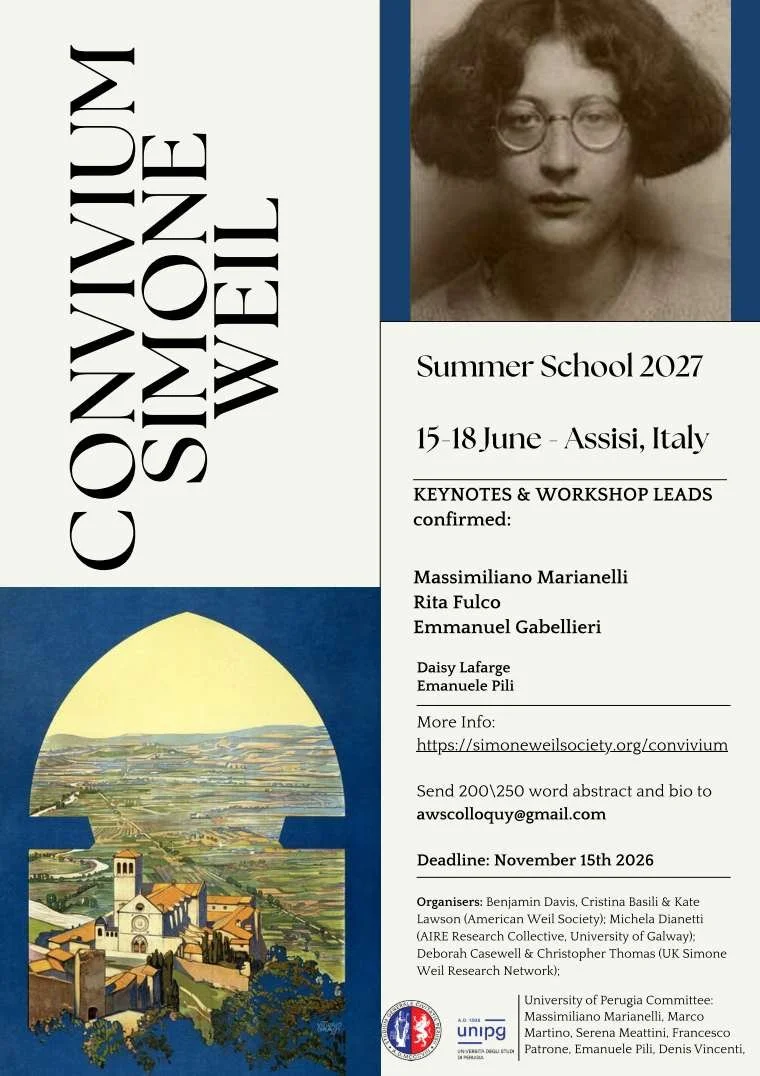
A collaboration between the American Weil Society, The UK Simone Weil Research Network, AIRE Research Collective (University of Galway), and the University of Perugia.
About the Summer School
In 1937, Simone Weil arrived in Assisi and found, in her own words, a ‘homeland of the soul’. She had prepared for the visit by reading the Fioretti, and she would later describe the Umbrian countryside as luminous, evangelical, Franciscan, a place where ‘nothing is the product of human industry’, where poverty was not asceticism but a way of grasping every joy in its fullness. It was here, before the frescoes of Giotto, that something in her opened: a vocation for poetry that had lain dormant since adolescence, and a deepened sense of what she would later call attention, and grace. For Weil, Italy was never simply a place of aesthetic pleasure. It was where beauty, contemplation, and a politics of attention met.
This summer school, 90 years after Weil’s experience in Assisi, takes her own encounter with the Franciscan town as its point of departure to explore the deeper questions her thought continues to pose: what peace as a spiritual and ethical practice looks like between mysticism and political activism, the tension between rootedness and uprootedness, in a century of displacement marked by the rise of neo-fascisms.
Venue
The summer school will be held at Palazzo Bernabei, Assisi, a building affiliated with the University of Perugia, in the very heart of the town that so moved Weil herself. The summer school is held at Palazzo Bernabei, the same building in which, in February 2026, universities from across Italy and Europe gathered to sign the Carta di Assisi, affirming the role of universities as ‘bridges of peace’ in a time of conflict and polarisation, and in the year of the 800th anniversary of the death of St. Francis. We take this convergence as a prompt and an invitation: to ask what Weil's thought, rooted in this very city, in its Franciscan spirit of poverty, fraternity, and attention to the other, has to offer to the urgent question of peace in the present.
We are working on group a group rate for accommodations with the local Franciscan community. Or you are welcome to find your own accommodations. Details to follow.
Call for Abstracts
For this session, we invite papers that engage with Simone Weil’s philosophy broadly construed, as well as papers that situate her in dialogue with other thinkers and traditions.
We particularly welcome contributions that explore the following (non-exhaustive) thematic strands:
Peace: Attention\Force: At the heart of Weil’s political philosophy is the opposition between attention and force. Force turns persons into things; attention restores them. What does a Weilian account of peace look like, not as political settlement but as ethical and spiritual practice? How does her reading of the Iliad, of affliction, and of obligation bear on contemporary debates about violence and war? How does peace sit between the binomial between mysticism and activism.
Mysticism and Activism: Weil’s own life refused the separation between contemplative withdrawal and political engagement. What does Weil, in her Franciscan spirit, offer to contemporary debates on the relationship between spiritual practice and activism? How might her notion of attention serve as a bridge between mystical experience and political activism?
Migrations of Body and Soul: Weil wrote as an exile, a factory worker, a soldier-in-waiting, a woman without a settled home. Her concept of enracinement (rootedness) sits in productive tension with her own restless itinerancy. We welcome papers addressing migration (historical, political, spiritual, or metaphorical) in Weil's work and its afterlives, including its bearing on contemporary debates on migration and displacement in Italy, Europe, and beyond.
Legacies and Interlocutors: We welcome contributions from scholars working on adjacent figures, traditions, or methodologies who wish to bring their work into conversation with Weil's on questions of theology, migration, and politics.
We invite 200-400-word abstracts for 15-minute papers addressing the topics mentioned above by 15 November to awscolloquy@gmail.com
Please include:
Name and institutional affiliation
A short bio (max 100 words)
Paper title and abstract (max 200-250 words)
Submissions
The Summer School welcomes PhD students and early-career researchers, BUT it is also open to researchers at any stage of their career, readers of Weil, artists, practitioners, teachers. Selected participants will present their work in a dedicated session, with feedback and mentoring from established Weil scholars present at the summer school.
The Summer School will be held in English, but we welcome presentations in Italian, French, German, Spanish, etc.